.svg)


.svg)
.svg)









- Loading...
.svg)
Four Decades of Taking On Hospitals and Medical Device Makers
These cases sit at the intersection of two areas the Jacob D. Fuchsberg Law Firm has handled for more than 40 years: medical negligence against hospitals and product liability against manufacturers. Managing Partner Alan L. Fuchsberg leads the firm's class action, mass tort, and product liability work alongside its medical malpractice practice, enabling one team to pursue the device maker and the treating hospital in the same investigation.
The firm is ranked Tier 1 for Medical Malpractice and Personal Injury in New York City by U.S. News Best Law Firms for 2026, and attorneys Alan Fuchsberg and Bradley Zimmerman are both recognized by Best Lawyers in America for plaintiff-side litigation. We work on a contingency basis, so you pay nothing unless we recover compensation for you, and your case stays with senior partners rather than being handed off. We also provide representation in Spanish.

.svg)
How an Olympus Scope Can Lead to Sepsis
An Olympus endoscope infection occurs when bacteria left on a reusable scope are transmitted to the next patient during a procedure. Olympus makes the flexible, camera-tipped tubes doctors use to see and treat organs without open surgery. The most scrutinized device is the duodenoscope, used in Endoscopic Retrograde Cholangiopancreatography (ERCP), which is performed roughly 500,000 times a year in the United States to reach the bile ducts and pancreas, according to the U.S. Department of Justice.
The danger is where these scopes go. A duodenoscope is guided into the bile duct, one of the few places in the body with no defense against gut bacteria. A contaminated scope can deposit organisms directly where they enter the bloodstream, and a localized infection can escalate into sepsis, the body's overwhelming response to infection, within days.
#cta_start
Did an Olympus Scope Leave You Fighting Sepsis?
A treatable infection can turn life-threatening when a hospital waits too long to act. Tell us what happened, and we will investigate at no cost to you.
#cta_end
The Design Flaw Behind the Superbug Outbreaks
At the tip of the duodenoscope is a moving part called the elevator channel, which angles surgical tools during a procedure. Its tight crevices are hard to clean and can trap tissue and bacteria even when staff follow the reprocessing instructions exactly. That is why these devices keep transmitting infection.
The government's own data show it. In FDA-ordered surveillance, a prospective study at 16 U.S. sites found that 4.1% of newer Olympus duodenoscopes and 6.6% of older models were still contaminated with high-concern organisms after cleaning. The FDA's postmarket program reported similar results, and a systematic review estimated a pooled rate of near 5% even after enhanced disinfection
At least 20 multidrug-resistant outbreaks were linked to these scopes between 2012 and 2015 despite reported compliance with cleaning procedures, according to an ongoing federal study. The numbers were high enough that the FDA dropped its earlier "relatively low risk" language and began urging a move to disposable-component scopes. The organisms involved often include Carbapenem-Resistant Enterobacteriaceae (CRE), which are resistant to last-resort antibiotics.
Warning Signs of an Infection After a Scope Procedure
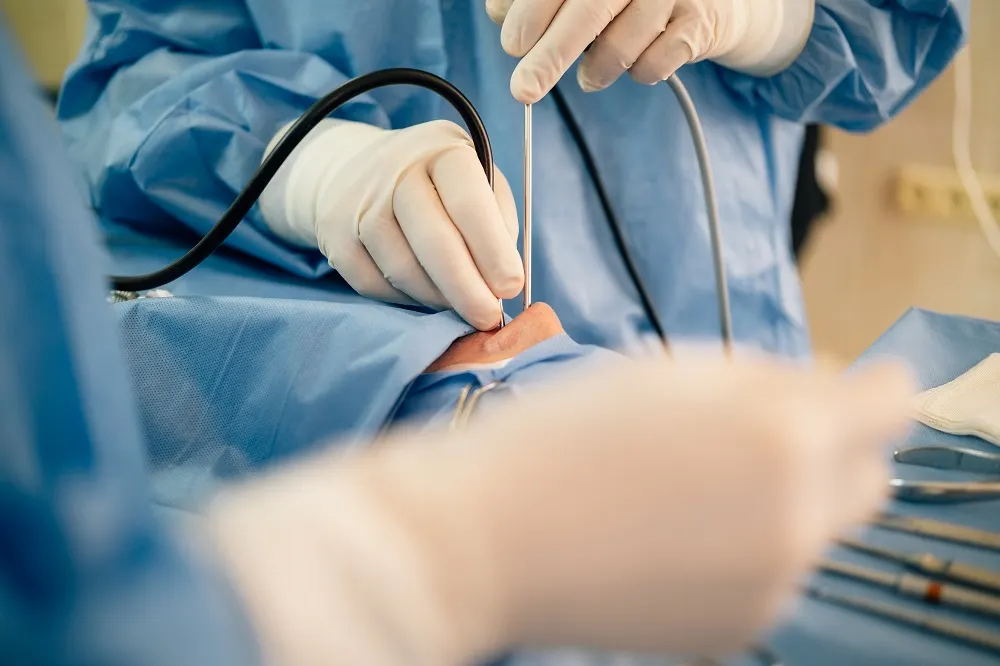
Recognizing post-procedure sepsis early is what separates a treatable infection from a catastrophe. Symptoms usually appear within days of an endoscopy or ERCP, though some surface weeks later, and they can escalate quickly. Watch for:
- Fever, chills, or shaking that starts after the procedure;
- Severe or worsening abdominal pain, nausea, or vomiting;
- A racing heart, rapid breathing, or low blood pressure;
- Confusion, disorientation, or a sudden drop in alertness;
- Jaundice, dark urine, or signs of a bile-duct infection (cholangitis).
Any of these after a recent scope procedure warrants immediate medical attention. When a patient reports these symptoms and the treating team fails to test for infection or start antibiotics promptly, that delay can become its own basis for a claim, separate from the device itself.
Two Ways an Olympus Scope Infection Becomes a Case
Most firms treat these as a single fight against Olympus. We look at two potential defendants, because a scope-infection injury can involve both a defective product and negligent care.
First Way: Product Liability Claim
The first is a product liability claim against Olympus, alleging the scopes were defectively designed, that the company failed to warn about a known contamination risk, and that its cleaning instructions were never enough to make the device safe. That is not speculation: in December 2018, Olympus Medical Systems and a former executive pleaded guilty in federal court in Newark to failing to file FDA-required adverse-event reports, paying $80 million in fines and a $5 million forfeiture after duodenoscope infections went unreported.
Second Way: Medical Malpractice Claim
The second is a medical malpractice claim against the hospital, which may be liable for reprocessing a scope improperly, using a device it knew was flagged, failing to diagnose and treat sepsis in time, or failing to tell patients they were exposed. This is where the sepsis injury is often decided, and it is the part most scope-lawsuit pages leave out. Your case may pursue one defendant or both, and each has its own New York deadline.
#cta_start
Did an Olympus Scope Leave You Fighting Sepsis?
Every hour a hospital delays treating an infection matters, and so does every hour before a deadline runs. Tell us what happened, and we will investigate at no cost to you.
#cta_end
Do You Qualify to File an Olympus Scope Infection Claim
Not every infection after a procedure is a lawsuit, but a strong claim usually shares a few features. You may have a case if:
- You underwent an endoscopy, ERCP, colonoscopy, bronchoscopy, or similar procedure involving a reusable Olympus scope, generally in 2015 or later;
- You developed a serious infection or sepsis afterward, usually within about 30 days, that required hospitalization, IV antibiotics, surgery, or ICU care;
- You were diagnosed with a drug-resistant or superbug infection such as CRE, E. coli, Klebsiella, or Pseudomonas;
- You received a letter from a hospital notifying you that you may have been exposed to contamination from a scope;
- You lost a family member to an infection that followed a scope procedure.
Many patients never learn which device was used during their procedure. That is normal, and it does not end your case. Medical records, procedure logs, and hospital device-tracking data can establish the connection, and our attorneys obtain those records for you.
The Toll of a Preventable Scope Infection
A contaminated-scope infection rarely stays contained to one hospital stay. The families we represent often face consequences that reshape lives or end them. These include:
- Sepsis and septic shock, which can cause a rapid, body-wide collapse in blood pressure and organ function;
- Organ failure affecting the kidneys, liver, or lungs;
- Prolonged ICU admission, repeat procedures, and months of IV antibiotic treatment;
- Long-term complications such as lasting organ damage, weakness, or cognitive effects after severe sepsis;
- Wrongful death, when the infection outpaces any treatment.
These outcomes shape both the medical proof and the damages in a claim, which is why we document them closely from the first records request.
Compensation You May Recover

The value of a scope-infection claim depends on the severity and permanence of the harm, the cost of care, and the extent to which the device maker or hospital departed from accepted standards. New York law allows recovery for both economic and non-economic losses.
Economic damages can include:
- Past and future medical expenses, including ICU care, surgeries, and rehabilitation;
- Lost wages and reduced earning capacity when injuries keep a patient from working;
- The cost of long-term care, home health services, or assistive equipment;
- Funeral and burial costs in wrongful death cases.
Non-economic damages can include:
- Physical pain and suffering;
- Emotional distress and loss of enjoyment of life;
- Loss of consortium money damages for a spouse or family member.
Unlike many states, New York places no cap on non-economic damages in these cases. A jury can hear the full scope of what a family has lost without an artificial ceiling.
New York Deadlines for an Olympus Scope Infection Case
The filing window depends on who caused the harm, and missing it can end a case before it starts. A medical malpractice claim against a hospital or doctor generally must be filed within two years and six months of the negligent act under CPLR 214-a. A product liability claim against Olympus runs on the standard three-year personal injury statute under CPLR 214.
Two New York rules matter especially here. Because many patients learn of an exposure only when a hospital sends a notification letter, the discovery provisions of CPLR 214-c can affect when the clock starts on a latent injury. And if the procedure took place at a public hospital, such as one run by NYC Health + Hospitals, a formal Notice of Claim must be filed within 90 days under General Municipal Law 50-e, well before the ordinary lawsuit deadline.
For a child, the malpractice deadline is generally paused until age 18, subject to an overall 10-year cap. Because these deadlines are strict and can differ by defendant, it is worth speaking with our experienced infection lawyers as soon as you suspect something went wrong.
Why Olympus's Track Record Matters to Your Case
The regulatory history of these devices is evidence that the risk was known long before many patients were exposed. The FDA warned providers in 2015 that manufacturer cleaning instructions might not fully disinfect these scopes, and the 2018 guilty plea established that Olympus withheld infection reports while continuing to sell the devices. Ongoing FDA surveillance kept finding unacceptable contamination. For a patient's case, that timeline helps demonstrate a manufacturer had notice of a defect and establish the medical standard hospitals were expected to meet.







.svg)
.svg)



.avif)