.svg)


- Loading...
Incarceration does not strip a person of their right to be safe. Every person held in a correctional facility (regardless of their conviction) is protected by federal and state law from sexual abuse and assault in prison. Yet sexual violence behind bars remains a widespread, underreported crisis, and survivors often don't know they have the right to seek civil compensation.
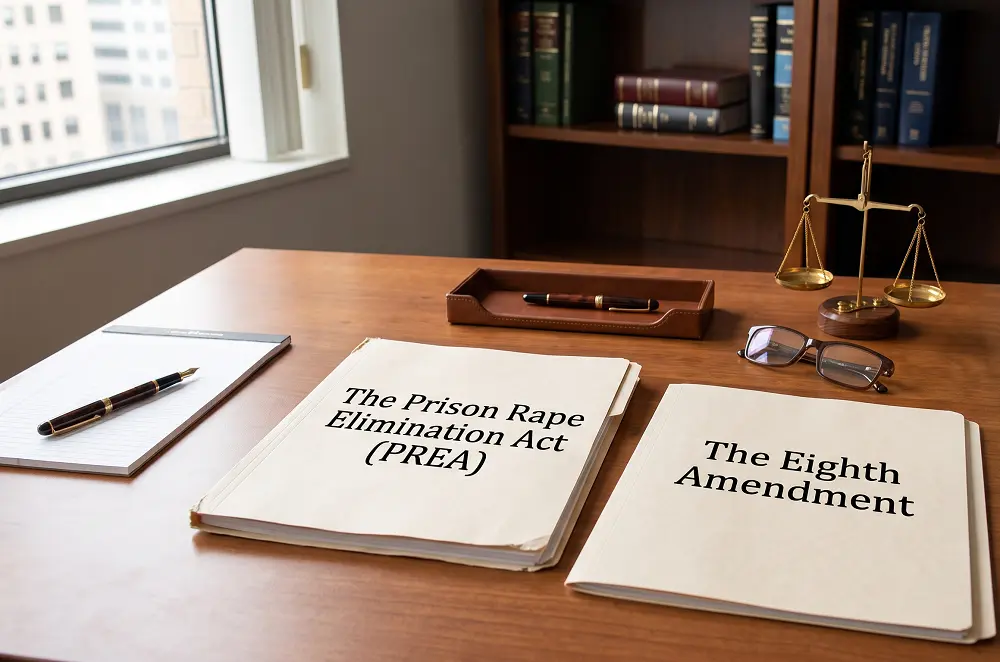
The Law That Protects You: PREA and the Eighth Amendment
Two primary legal frameworks protect incarcerated people from sexual abuse in the United States.
The Prison Rape Elimination Act (PREA)
The Prison Rape Elimination Act (PREA), signed into federal law in 2003, requires all correctional facilities, including federal, state, and local, to maintain a zero-tolerance policy toward sexual abuse and misconduct. Under PREA, all sexual contact between staff and inmates is prohibited without exception. Consent is not a defense. The power imbalance between a correctional officer and an inmate is so significant that the law treats any such contact as inherently abusive. New York's Department of Corrections and Community Supervision (DOCCS) enforces PREA standards across all state facilities and investigates all reported violations.
The Eighth Amendment
The Eighth Amendment to the U.S. Constitution, which prohibits cruel and unusual punishment, also protects incarcerated individuals from sexual abuse and deliberate indifference to serious harm. Survivors can bring civil rights claims under 42 U.S.C. § 1983 against individual correctional officers and against the institutions that failed to protect them.
These two legal tools (the PREA and constitutional civil rights law) form the basis for most prison sexual assault lawsuits.
Forms of Sexual Abuse in Prison
Sexual assault in prison takes different forms, and each carries legal weight in a civil claim. The most common include:
- Unwanted physical contact: non-consensual touching, groping, or grabbing of any part of the victim's body;
- Physical sexual assault: the use of force or coercion to carry out a sexual act;
- Rape: non-consensual penetration or sexual intercourse.
Any of these acts, when committed by staff or enabled by institutional failures, can form the basis of a civil lawsuit.
Who Can Be Held Liable for Sexual Abuse in Prison
One of the most important things survivors need to know is that liability often extends well beyond the individual who committed the assault.
The following parties may be named as defendants in a civil lawsuit:
- The correctional officer or staff member who committed the assault;
- Supervisors who knew — or should have known — about the abuse and failed to stop it;
- Other staff members who witnessed abuse and did not intervene;
- The correctional facility or institution that created a culture permitting misconduct;
- Government agencies responsible for overseeing the facility.
This matters because the individual perpetrator may have limited financial resources. Holding the institution accountable can significantly increase the compensation available to survivors.

Case Study: Jacob Fuchsberg Law Firm Obtains Historic $3 Million Settlement
In 2022, attorney Jaehyun Oh of the Jacob D. Fuchsberg Law Firm represented three incarcerated women who were sexually assaulted by a correctional officer at the now-closed Manhattan Correctional Center in New York.
The lawsuit was brought forward not only against the officer but also against the United States Federal Government for failing to take action against the abuse.
- The result: A historic $3 million settlement, which at the time was the largest settlement nationwide awarded against the Federal Bureau of Prisons in a case involving inmate sexual assault.
- The impact: Following the settlement, Jaehyun Oh and plaintiff Carolyn Richardson testified before Congress. Less than two weeks later, the Prison Camera Reform Act was signed into law to eliminate "blind spots" in prisons.
Currently, Jaehyun Oh represents hundreds of incarcerated women nationwide, continuing the fight for systemic reform.
Barriers Survivors of Sexual Abuse Often Face
Pursuing a civil claim while incarcerated is not straightforward. Survivors face real and serious obstacles that can make coming forward feel impossible, but these challenges do not eliminate the right to seek justice.
- Fear of retaliation is among the most significant. Survivors risk punishment from their assailants or facility staff, including disciplinary write-ups, loss of privileges, or placement in solitary confinement. Documented retaliation, however, can itself become evidence in a civil case.
- Limited access to legal resources is another barrier. Incarcerated individuals often have restricted access to phones, mail, and attorneys, all of which are necessary to build a claim. An experienced prisoner rights attorney can work around these restrictions to effectively reach and represent clients.
- Psychological trauma and stigma also weigh heavily. The trauma of assault, combined with the stigma of being an incarcerated person, can make it difficult to come forward at all. These psychological effects are not just personal struggles, but are documented, compensable damages in a civil lawsuit.
What Can Your Prison Sexual Assault Claim Cover
A civil settlement in a prison sexual assault case can include several categories of damages.
Economic damages cover quantifiable financial losses:
- Medical expenses, including treatment for physical injuries;
- Mental health treatment, therapy, and counseling costs;
- Lost wages and diminished earning capacity after release;
- Future medical and psychiatric care costs.
Non-economic damages compensate for harm that is real but harder to quantify:
- Pain and suffering;
- Emotional distress and mental anguish;
- Post-traumatic stress disorder (PTSD), depression, and anxiety;
- Humiliation and loss of dignity;
- Diminished quality of life.
Punitive damages may also apply in cases where the defendant's conduct was especially egregious or involved deliberate indifference to known risks. Courts have awarded punitive damages in prison sexual abuse cases to punish institutions that covered up misconduct or retaliated against survivors who came forward.

What Drives the Settlement Amount
There is no set formula for calculating what a prison sexual assault case is worth. Settlement values vary significantly based on the specific circumstances. The factors most commonly considered include:
- Severity and nature of the abuse. Cases involving rape, repeated assault, or abuse that continued over an extended period of time generally result in higher settlements than isolated incidents of unwanted touching.
- Physical and psychological impact. When survivors sustain lasting physical injuries or are diagnosed with serious mental health conditions (particularly PTSD), their damages are more serious and require higher settlement amounts. Medical documentation of these effects plays a critical role.
- Institutional failures. If evidence shows that facility administrators ignored warning signs, suppressed complaints, or retaliated against survivors, courts and juries tend to award substantially more.
- Quality of evidence. Medical records, PREA complaint filings, witness testimony, surveillance footage, and documented retaliation all strengthen a claim. Gathering this evidence promptly after an assault significantly affects the outcome.
- Prior legal history. Settlements tend to be higher against institutions that have faced prior lawsuits for similar conduct, because this history demonstrates awareness and inaction.
- Representation. Having an attorney experienced in prisoner civil rights and federal litigation affects both what claims can be filed and how effectively they are pursued.
What to Do After Sexual Assault in Prison
If you or a loved one has been sexually assaulted in a correctional facility, the following steps help preserve your rights:
- Seek medical attention as soon as possible. A medical exam documents injuries and preserves physical evidence.
- File a PREA report with the facility's designated coordinator or through the anonymous PREA hotline.
- Document everything in writing, including the date, time, location, description of the assault, names of any witnesses, and any retaliation that follows.
- Keep copies of any correspondence, grievance filings, and responses you receive.
- Contact an attorney who focuses their law practice on prisoners' civil rights before the notice-of-claim deadline passes. Time is of the essence.
Statute of Limitations for Prison Sexual Assault Claims in New York
For federal facilities (Bureau of Prisons), survivors must file a Standard Form 95 (SF-95) administrative claim within 2 years of the incident before pursuing a lawsuit.
For New York State and city or county facilities, survivors typically must file a notice of claim or notice of intention within 90 days of the incident. Failure to file on time can bar the claim entirely, though there are narrow exceptions.
Under PREA, initial reports should be filed with the facility's PREA coordinator.
Because these deadlines can be unforgiving, contacting an attorney as early as possible after an assault is strongly recommended.
FAQ
Frequently Asked Questions
Can I still sue if the encounter was "consensual"?

Under the Prison Rape Elimination Act (PREA), there is no such thing as "consent" between an inmate and a staff member. Because of the inherent power imbalance, any sexual contact is legally considered abusive and prohibited.
What is the statute of limitations for filing a claim in New York?
It depends on the facility. For New York State or city facilities, you usually must file a Notice of Claim or Notice of Intention within 90 days. For federal facilities, you have 2 years to file an administrative claim (SF-95). Because these windows are short, you should contact a lawyer immediately.
Can I file a lawsuit if I have already been released from prison?
Yes. As long as the statute of limitations has not expired, you can seek compensation for abuse that occurred while you were incarcerated, even if you are now a free citizen.
Will I be retaliated against for reporting the assault?
While the fear of retaliation is real, the PREA law strictly prohibits it. Furthermore, any documented retaliation by guards or administration can actually strengthen your legal case and increase potential damages.
Don’t Let a Deadline Cost You the Chance to Seek Justice
If you believe you've been assaulted in a prison or detention facility, time may be running out to file. Contact the Jacob D. Fuchsberg Law Firm now for a free case review that will only take just minutes and could make all the difference.
Talk to the Jacob D. Fuchsberg Law Firm
Your window to act may be shorter than you think. The Jacob D. Fuchsberg Law Firm has held correctional facilities and the Federal Government accountable for sexual abuse behind bars. Contact us today for a free, confidential case evaluation. You pay nothing unless we recover money for you.