.svg)


- Loading...
When something goes seriously wrong during delivery, the electronic fetal monitoring (EFM) strip in your delivery records either shows a late deceleration, a climbing baseline, or it doesn't. That single detail often decides whether your child's brain injury could have been prevented.
At the Jacob D. Fuchsberg Law Firm, our New York birth injury attorneys have decades of experience holding medical providers accountable when they ignore or misinterpret signs of fetal distress. We understand the medical science behind these cases and fight relentlessly to secure the resources your family needs.
Fetal Monitoring and Why It Matters During Labor
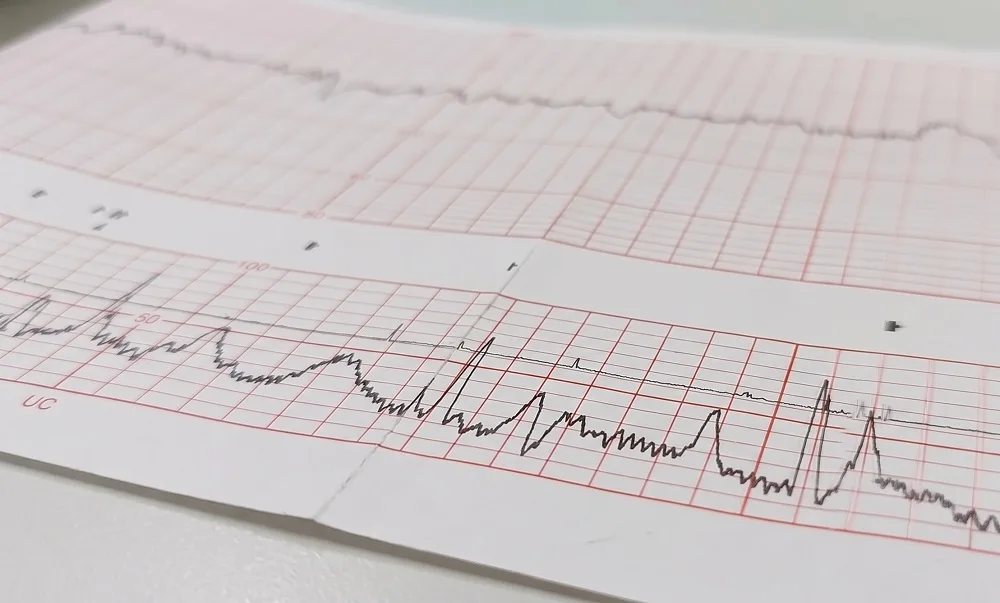
Fetal heart monitoring is a standard procedure used during labor. A device called a transducer, placed on the mother's abdomen, uses ultrasonic waves to track your baby's heart rate alongside your contractions. This monitoring serves a fundamental purpose: detecting when your baby isn't getting enough oxygen. When reading your delivery records, look for the words "reassuring" and "non-reassuring" — that's the language doctors and nurses actually write in the chart, more often than the Category I, II, or III labels covered below.
Despite what some defense attorneys and hospitals claim, fetal heart monitoring is not just a formality. Electronic fetal monitoring is used in nearly 85% of births nationwide, according to a joint report from the Healthcare Association of New York State, ACOG, and the New York State Department of Health. Used and interpreted correctly, it can warn the obstetrical team of complications that may lead to neonatal brain injury.
Common Types of Fetal Heart Rate Patterns
Medical professionals should recognize and respond to specific patterns that appear on fetal monitoring strips:
- Baseline heart rate: A normal fetal heart rate ranges from 110 to 160 beats per minute. Rates consistently above or below this range may indicate problems.
- Early decelerations: A gradual decrease in heart rate that bottoms out at the same time as the contraction's peak, then returns to baseline. This pattern is generally benign and often results from head compression during a contraction.
- Late decelerations: Heart rate gradually decreases after a contraction starts, with the lowest point occurring after the contraction peaks. Late decelerations may indicate the placenta isn't providing enough oxygen to your baby.
- Variable decelerations: An abrupt drop in heart rate of 15 beats per minute or more, reaching its lowest point in under 30 seconds and lasting between 15 seconds and 2 minutes, often results from umbilical cord compression and requires immediate attention when severe or repetitive.
- Tachycardia: A baseline heart rate consistently above 160 beats per minute may indicate infection, maternal fever, or fetal distress.
- Bradycardia: A baseline heart rate consistently below 110 beats per minute can signal serious oxygen deprivation.
- Minimal or absent variability: A healthy baby's heart rate naturally varies from beat to beat, and the absence of this variability often indicates distress.
- Prolonged deceleration: A drop in heart rate lasting more than 2 minutes but less than 10. Depending on how low the rate falls and how it resolves, this can be an early sign that a Category II tracing is becoming a Category III emergency.
- Sinusoidal pattern: A smooth, regular, wave-like heart rate pattern that doesn't reflect normal variability. This pattern is treated as abnormal on its own and is one of the few findings that automatically places a tracing in Category III.
A pattern on the screen only tells half the story. How a doctor or nurse responds to it, and how quickly, is where most of these cases are actually won or lost.
How ACOG Guidelines Protect Doctors Instead of Babies
In 2008, a workshop convened by the National Institute of Child Health and Human Development, ACOG, and the Society for Maternal-Fetal Medicine introduced a three-tier system for classifying fetal heart rate patterns. ACOG formally adopted it in 2009 with Practice Bulletin Number 106. Many plaintiff attorneys and birth injury advocates believe these guidelines were crafted with medical-legal protection in mind rather than infant safety.
The guidelines use ambiguous terms like "Category II" (indeterminate) that cover a broad range of concerning patterns. Rather than recommending preparations for prompt delivery when fetal heart rate patterns suggest potential compromise, these 2009 guidelines essentially tell clinicians to "watch and wait" until the situation becomes an emergency.
This approach favors medical providers at the expense of babies. By the time a pattern is classified as "Category III" (abnormal), requiring immediate delivery, the baby may have already suffered irreversible brain damage. Even without immediate delivery, a worsening strip calls for action: repositioning the mother, supplemental oxygen, IV fluids, stopping Pitocin, or proceeding to an assisted delivery with forceps or vacuum. "Watch and wait" isn't the only alternative to a cesarean section, and a chart showing none of these steps were tried is its own red flag.
Common Defense Tactics: How Hospitals Try to Disprove Fetal Monitoring Claims
When you file a lawsuit, expect defendant doctors to claim that fetal heart monitoring isn't predictive of brain damage or cerebral palsy. This defense contradicts the very reason they use monitoring in the first place.
Our experienced attorneys know how to dismantle these arguments using authoritative medical evidence. We cite organizations such as the New York Health Foundation, which funds research on standardizing how hospitals interpret fetal monitoring strips.
We also use respected medical texts and articles that provide scientific evidence that a significant fraction of cerebral palsy cases involve oxygen deprivation during labor and delivery.
We also cite Joseph Volpe's Neurology of the Newborn (4th ed., 2001), which found that 12% to 23% of cerebral palsy cases can be related to intrapartum asphyxia. That might sound like a minority of cases, but cerebral palsy affects roughly 2 to 3 children out of every 1,000 born. Even a modest percentage of that total caused by labor and delivery events adds up to a large number of preventable injuries.
Markers of Hypoxic-Ischemic Encephalopathy

To prove your case, we must demonstrate that medical negligence caused hypoxic-ischemic encephalopathy (HIE), which is brain damage from oxygen deprivation. Key markers include:
- Low Apgar scores: Scores of less than 5 at both 5 and 10 minutes after birth indicate severe distress.
- Umbilical cord blood gases: A pH level below 7.0 or a base deficit of 12 mmol/L or greater confirms severe oxygen deprivation and acidemia.
- Neuroimaging evidence: Brain MRI or MRS scans may show injury patterns consistent with oxygen deprivation.
- Multi-organ failure: Damage to the kidneys, liver, heart, or other organs may be consistent with severe oxygen deprivation.
These markers reflect a physiological process where your baby became severely compromised during labor. As oxygen levels drop, the baby's body first compensates by increasing heart rate. As the condition continues, the baby starts burning through glucose reserves, and lactic acid begins building up in the blood. Eventually, the body starts shunting oxygenated blood to the most vital organs, including the heart, brain, and adrenal glands, at the expense of everywhere else. If the condition persists, brain cells begin to die, particularly in areas responsible for movement, cognition, and breathing.
Additional Risk Factors in Fetal Monitoring Cases
Monitoring errors are often compounded by other forms of negligence, such as:
- Excessive Pitocin use: Pitocin increases the frequency, duration, and intensity of contractions. Overstimulation (tachysystole) can reduce oxygen flow to the baby between contractions, causing distress.
- Protracted or arrested labor: Labor that progresses too slowly (protracted) or stops altogether (arrested) depletes the mother's and baby's oxygen reserves, making proper monitoring even more essential. Signs like molding (temporary shaping of the baby's skull) or caput (scalp swelling) from extended pressure during labor can also help establish how long and how hard labor actually was.
- Meconium-stained amniotic fluid: The presence of meconium (the baby's first stool) in the amniotic fluid indicates the baby experienced stress and increases the risk of serious complications.
- Abnormal fetal presentation: Babies in breech or other abnormal positions may not tolerate labor as well as those in normal head-down positions.
- Placental problems: Placental abruption (separation of the placenta from the uterine wall) or placental insufficiency can severely compromise oxygen delivery to your baby.
Any one of these factors can turn a manageable labor into an emergency. When more than one is present at the same time, the standard of care calls for closer monitoring, not less.
What Compensation Can You Recover
Birth injuries from fetal monitoring errors often result in lifetime disabilities requiring extensive medical care, therapy, and support. New York law allows you to seek compensation for:
- Medical expenses: All costs related to your child's treatment, including hospitalization, surgeries, medications, medical equipment, and future care needs.
- Rehabilitation and therapy: Physical therapy, occupational therapy, speech therapy, and other specialized treatments your child requires.
- Home and vehicle modifications: Changes needed to accommodate your child's disabilities, including wheelchair ramps, accessible bathrooms, and modified vehicles.
- Lost earning capacity: If your child's injuries prevent them from working in the future.
- Pain and suffering: Compensation for your child's physical pain and diminished quality of life.
- Parental claims: Recovery for parental emotional distress, particularly when the child was stillborn due to medical negligence.
For qualifying cases involving birth-related neurological injuries, as defined under New York Public Health Law § 2999-h, enrollment in the New York State Medical Indemnity Fund provides lifetime coverage for medical care, rehabilitation, custodial care, durable medical equipment, home modifications, assistive technology, vehicle modifications, and medications and medical supplies
Steps to Take If You Suspect Fetal Monitoring Errors

If you believe fetal monitoring errors contributed to your child's birth injury, taking the right steps can protect your legal rights:
- Obtain all medical records: Request complete copies of your prenatal records, including any placental pathology report, labor and delivery notes, fetal monitoring strips, your baby's newborn records, and records from any prior pregnancies that show a history of premature birth, preeclampsia, or gestational diabetes.
- Document your child's condition: Take photos and videos and keep detailed records of your child's diagnoses, treatments, therapies, medications, and how their injuries affect daily life.
- Preserve evidence: Save any correspondence with medical providers, bills, and insurance documents related to your delivery and your child's care.
- Don't sign releases: Hospitals and insurance companies may ask you to sign releases or settlement agreements shortly after your child's injury. Do not sign anything without consulting an attorney first.
- Contact an attorney quickly: Acting promptly preserves your rights and allows your attorney to gather evidence while it's still fresh.
Once those steps are underway, the next question is who, specifically, failed your family.
Who Can Be Held Accountable for Fetal Monitoring Errors
Multiple parties may share responsibility when fetal monitoring errors cause birth injuries:
- Obstetricians: Doctors who fail to properly interpret monitoring strips, delay necessary interventions, or make poor clinical decisions during labor.
- Labor and delivery nurses: Nurses who don't recognize concerning patterns, fail to notify physicians promptly, or inadequately document fetal status.
- Midwives: Certified nurse-midwives or other midwives who miss warning signs or fail to transfer care to a physician when complications arise.
- Hospitals: Medical facilities that have inadequate staffing levels, provide poor training, or have insufficient policies and protocols for responding to fetal distress.
- Anesthesiologists: Physicians whose medication administration causes or contributes to fetal distress without proper monitoring and intervention.
Our attorneys conduct thorough investigations to identify all potentially liable parties and pursue full compensation from each responsible party.
FAQ
Frequently Asked Questions
How do I know if fetal monitoring errors caused my child's birth injury?

Signs include concerning patterns on the fetal monitoring strips (late decelerations, bradycardia, absent variability) that were not acted upon, delays in performing a cesarean section despite non-reassuring patterns, and evidence of oxygen deprivation at birth (low Apgar scores, abnormal umbilical cord blood gases).
What is the statute of limitations for filing a birth injury lawsuit in New York?
Generally, medical malpractice cases must be filed within two and a half years of the alleged malpractice. However, for infants, the statute of limitations pauses until age 18, subject to an outer limit of 10 years from the date of the malpractice, though earlier action is always recommended.
How long does a birth injury case take to resolve?
Birth injury cases involving fetal monitoring errors typically take two to four years to resolve, though this varies based on case complexity, the severity of injuries, and whether the case settles or goes to trial.
Can I afford to hire a birth injury lawyer?
Our firm handles birth injury cases on a contingency fee basis, meaning you pay no attorney fees unless we recover compensation for you. We advance all case costs, so there's no financial risk to pursuing your claim.
What if multiple medical providers were involved in my care?
New York allows you to pursue compensation from every provider whose negligence contributed to the harm, and each one can be held responsible in proportion to their share of fault. We build the case against each defendant rather than settle for whichever is easiest to reach.
Will I have to go to court?
Many birth injury cases settle before trial, but we prepare every case as if it will go to court, and if a trial becomes necessary, we're always ready to fight for you.
Medical Negligence Shouldn't Rob Your Child of a Healthy Future
If your baby suffered brain damage due to fetal monitoring errors, our New York birth injury lawyers will investigate every detail of your labor and delivery records. We work with maternal-fetal medicine professionals to prove when medical staff failed to act on clear warning signs.
Do You Have Your Delivery Records? We'll Review Them at No Cost.
If you're seeing terms like "late deceleration", "Category II", or "non-reassuring" in your chart and don't know what they mean for your case, we do. Bring us the records, and we'll tell you what the strip means.
Your Baby Deserved Better Care
A missed pattern on a fetal monitor strip is not an acceptable explanation for a lifetime of disability. The Jacob D. Fuchsberg Law Firm has represented New York families in birth injury cases for generations, and we handle every case on a contingency basis, meaning you pay nothing unless we recover for you. Call us at (212) 869-3500 or use the form below to request a free case review.